
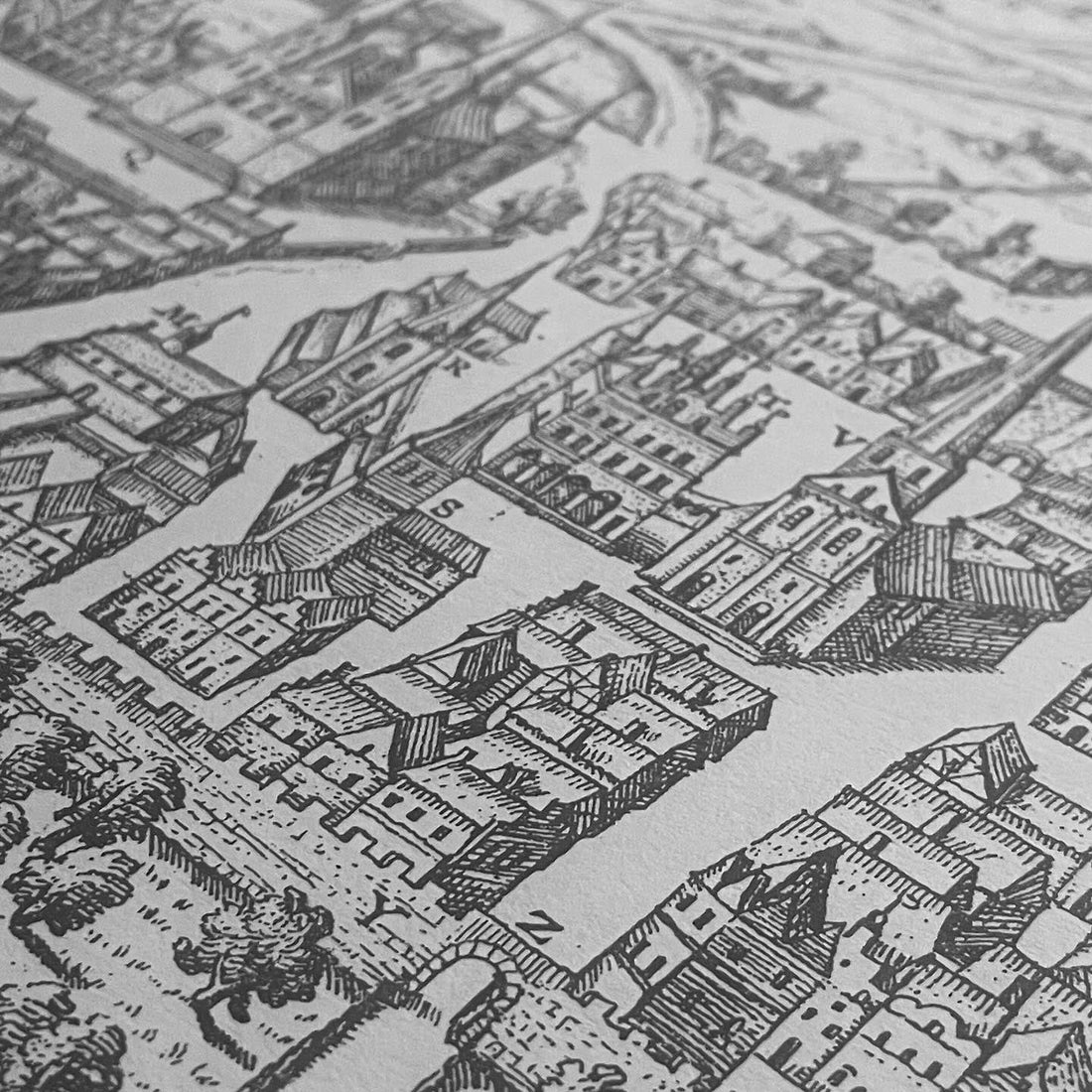
What distinguishes a digital print from our reproductions?
Can there really be that much difference between a digital print and our reproductions? After all, it is just a black-and-white print of an existing image?
Yes, that is a question one can reasonably ask. But there is a big difference. So big a difference that it can actually be seen with the naked eye.
The first thing you notice is the paper itself. The paper for our prints was chosen with great care by Robert, based on its natural properties. This means that the color tone of the paper, its texture, and its ability to bind the printing ink or watercolor—in the case of a hand-colored print—are central to how the image is perceived when you look at it. The paper adds warmth, you could say. And given how much of the print the paper shows through, you could say that it is a major part of how the print is perceived when it hangs on the wall.
This can be compared to a digital print based on a scanned image of an original, where the paper may have yellowed. In that case, a yellowed background color is printed on the paper, or in the worst case, a solid gray color, if the image was scanned in black and white.
Our prints have no “background color”; instead, the color and texture of the paper stand on their own.
The reason we have not included any background is due to how carefully Robert restored his works before they were printed. A task he carried out with the utmost care and precision. The methods could vary, but he often worked by making a photographic copy of an original and then meticulously masking the film that formed the basis for the printing plate. In this way, he removed tears, fold marks, holes, or bleed-through from the back of the print. Something that was quite common on old maps.
This means that our maps are free from unwanted artifacts. Furthermore, they have been photographed rather than scanned, which means you can be completely sure that there are no digital artifacts, such as an original being moved during scanning or a file becoming corrupted.
Below you can see an example of what a digital print from a scan can look like. I ordered this particular map online, and it does not represent the quality of our prints.

In the image above, you can see a couple of artifacts. Partly, there is bleed-through from the back of the print. It is clearest at the top of the map. But there are some other flaws that stand out more. In the middle of the map, you can make out a shadow running vertically through the image. That is where the original map had been folded, so it is a crease that could not be properly flattened before scanning. Another interesting thing is the emblem at the top center of the map. Part of the emblem is missing there, probably because some kind of shift occurred during scanning. Furthermore, many of the scanned images are sourced from the internet and have too low a resolution to produce a satisfactory result.
Now, this is just one such reproduction, and there are, of course, other maps that have been scanned better. But reproductions where tears, holes, and other imperfections remain and become part of the image are common. This can, of course, be decorative, but it is a completely different type of product from what I sell.
So, in summary, a print from us is carefully restored by hand, with a quality and finish that is above average. You can rest assured that our prints are free from digital artifacts such as pixelated images or misaligned scans, and that the choice of paper is always something above average. With us, you do not get a poster on coated paper; here, you will only find high-quality reproductions from a completely unique collection.