World Map - Typus Cosmographicus Universalis
World Map - Typus Cosmographicus Universalis
Sheet size: 620x500 mm
Sold without frame.
Couldn't load pickup availability
Delivery time within Sweden: 2-4 business days, within the EU: 4-7 business days. For special orders, such as hand-coloring or customization, delivery will be arranged by agreement.
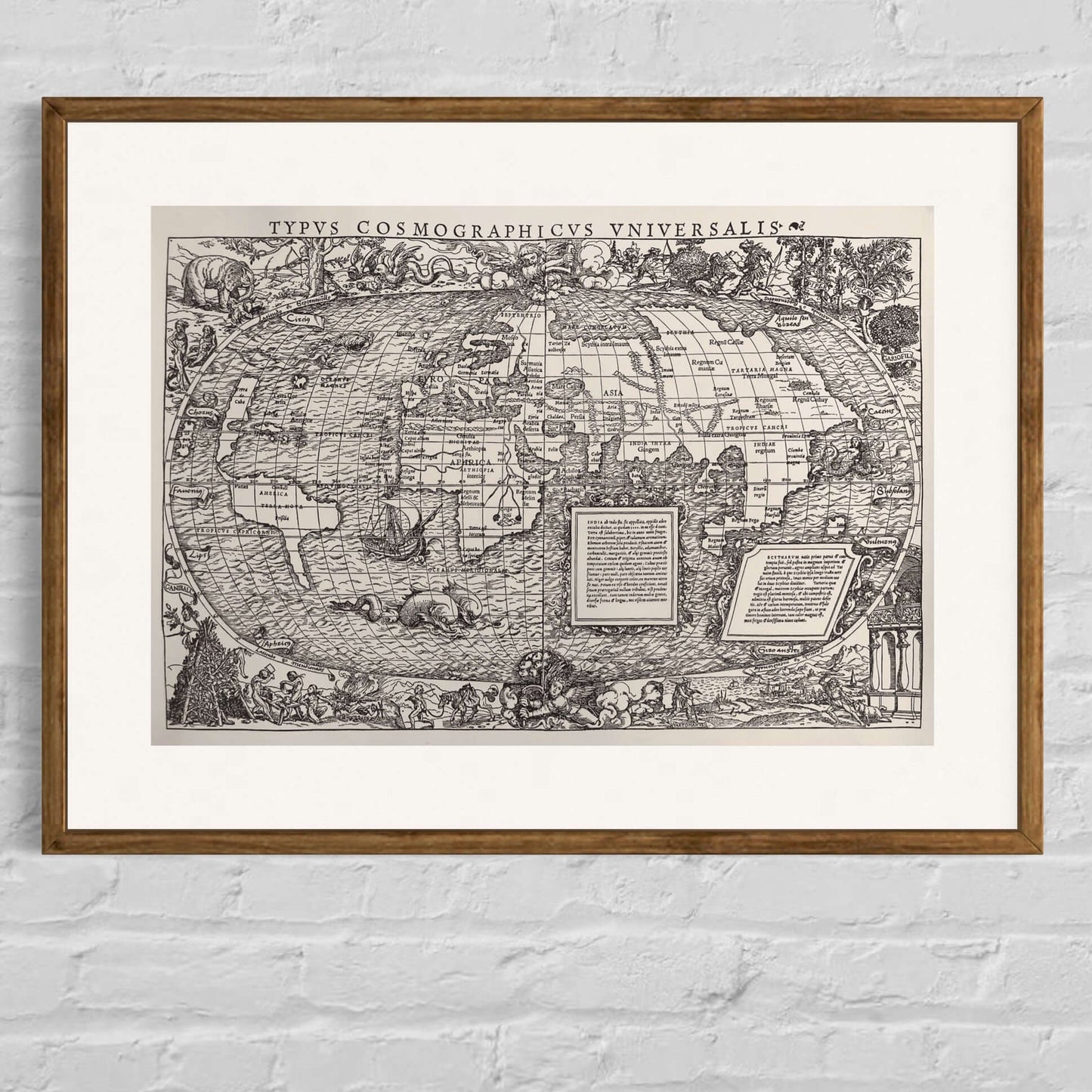
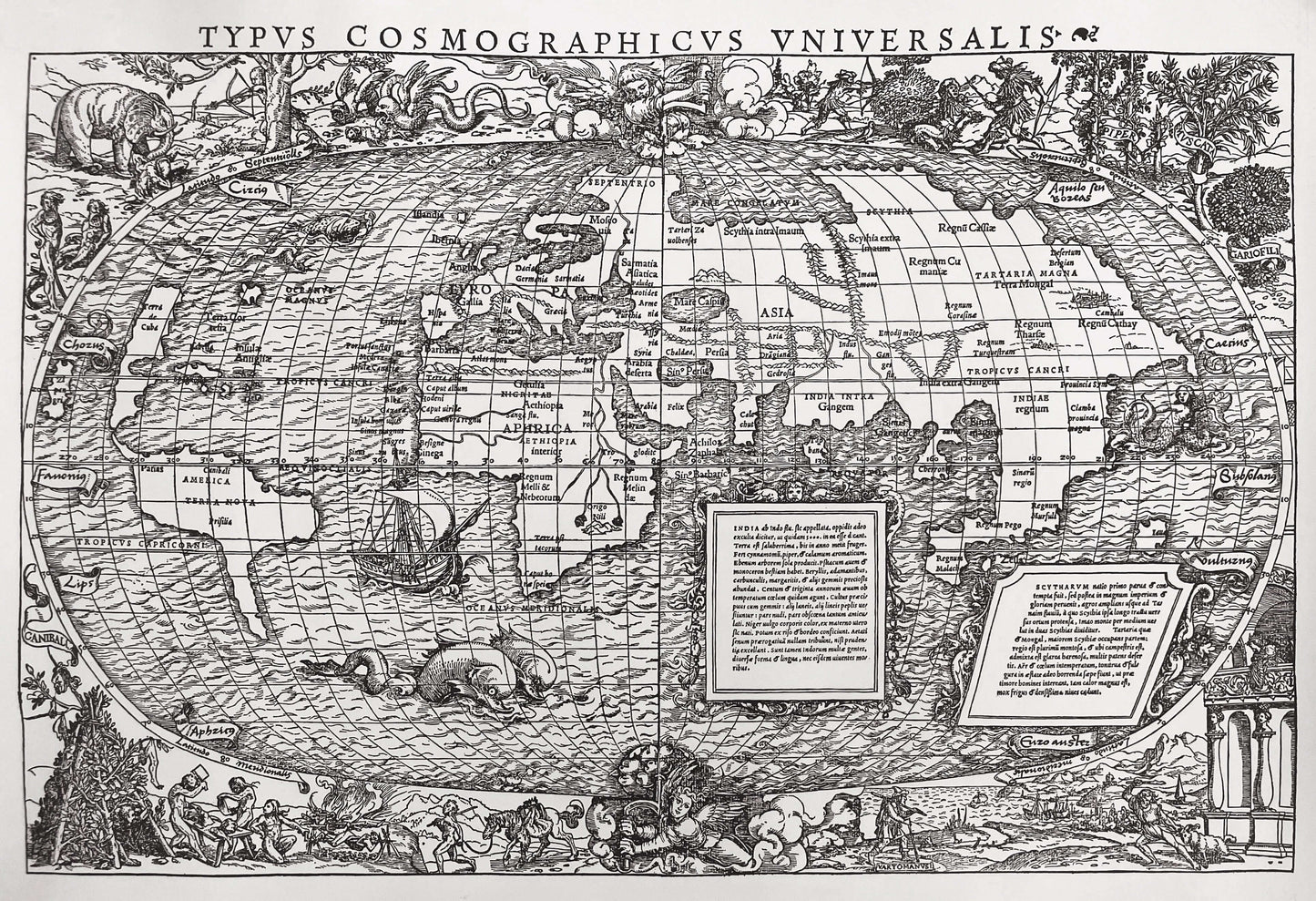
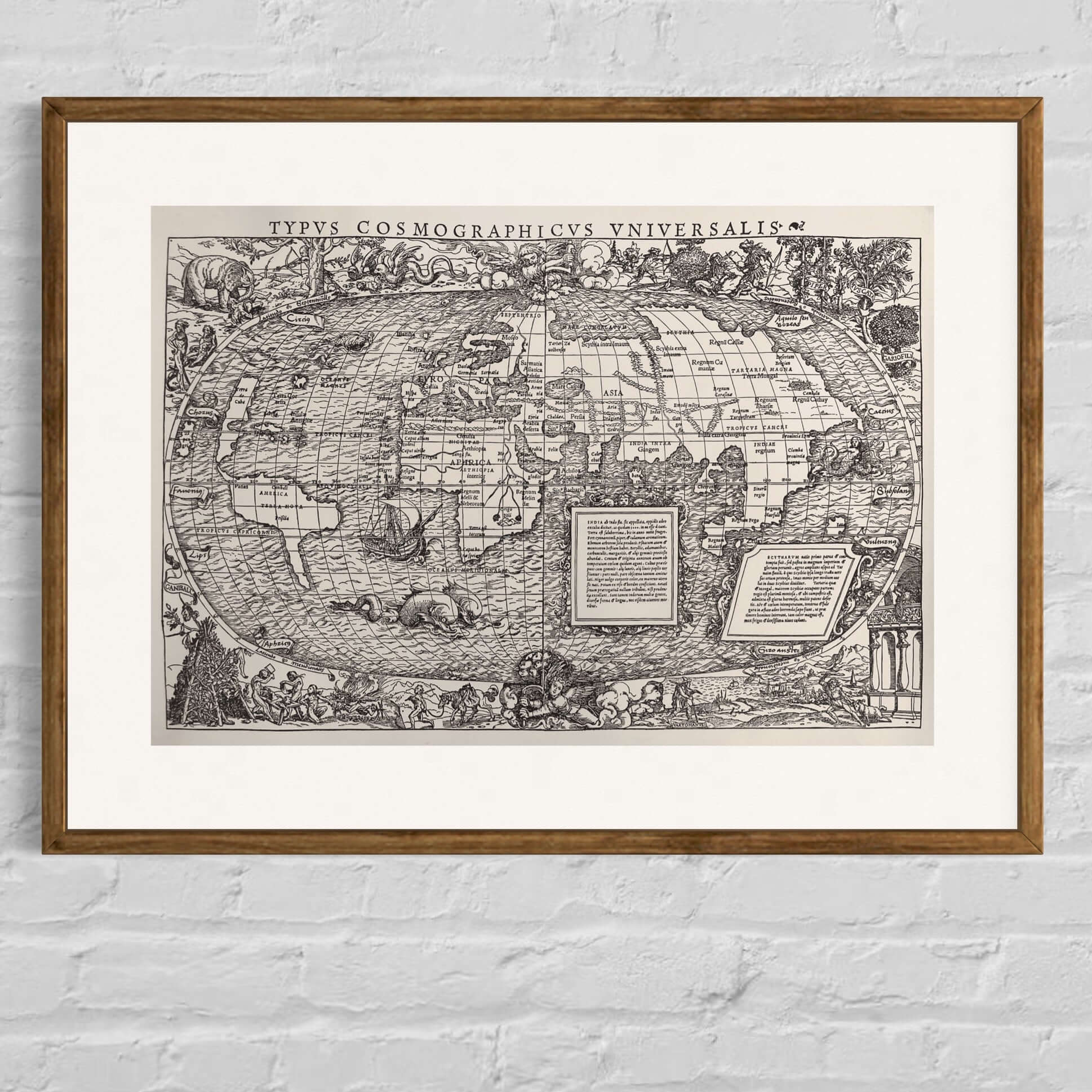
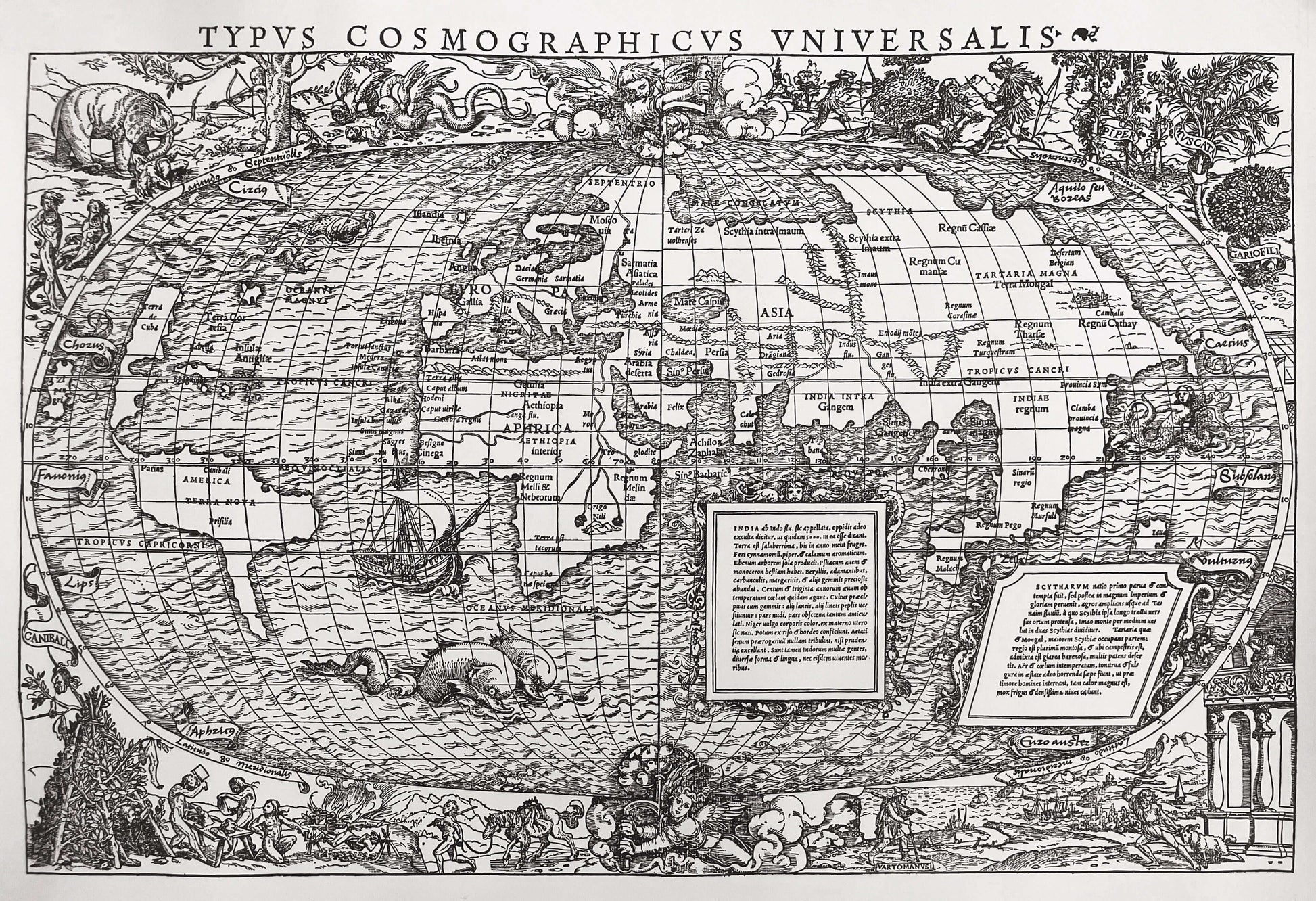
A reproduction of Sebastian Münster's world map Typus Cosmographicus Universalis, letterpress printed on handmade Lessebo paper.
Cartographer: Sebastian Münster.
Work: Typus Cosmographicus Universalis, first published in 1532.
Decorations: Attributed to Hans Holbein the Younger.
Technique: Letterpress printing.
Paper: Handmade paper from Lessebo.
Frame: Not included.
The Story Behind the Image
One of our real gems. A fantastic reproduction of one of the world's most sought-after antique maps. Typus Cosmographicus Universalis, first published in Novis Orbis Regionium, 1532.
The map is one of Münster's most famous
The map was created by Sebastian Münster (1488-1552), who was the most prolific cartographer of his time. He is best known for his major geographical work Cosmographia (Basel, 1540). Around the edges of the map are fantastical decorations. These have been attributed to Hans Holbein the Younger (1497-1543), one of the greatest artists of the Northern Renaissance. Holbein, originally from Augsburg, was working in Basel at the time before moving to London to become the official court painter to Henry VIII.
Holbein's design shows the world turned on its axis by cranks operated by a pair of angels. Some have theorized that this represents the first published depiction of the Copernican view of the Earth fixed on its axis while orbiting the sun (predating the publication of Copernicus's work in 1543). But there is no direct evidence for this, and it is probably just an artistic conceit.
In addition, the ornate borders feature imaginary scenes of cannibals, winged serpents, elephants, and monsters, all drawn from popular, but largely fictional, travel accounts of the period, particularly Amerigo Vespucci's Mundus Novus (1503).
The vignette marked 'Vartomanusi' in the lower right corner refers to the explorations of Southeast Asia carried out by the Bolognese adventurer Ludovico di Varthema (1470-1517). Varthema was famous as the first known Christian to visit Mecca, and from 1502 to 1507 he extensively explored India, Indochina, and the Indonesian archipelago. His account of his travels, Itinerario de Ludovico de Varthema Bolognese (Rome, 1510), was one of the most fascinating from the early period of global exploration. The vignette in the upper right corner depicts the spices that were the focus of trade with the East Indies.
The map is one of the most decorative and sought-after of all early world maps reasonably available to most collectors, thanks to the enormous success of the Huttich-Grynaeus text.
Our reproduction is not only carefully printed using letterpress, but is also printed on incredibly fine handmade paper from Lessebo.
The image is sold without a frame.
Framing Tips
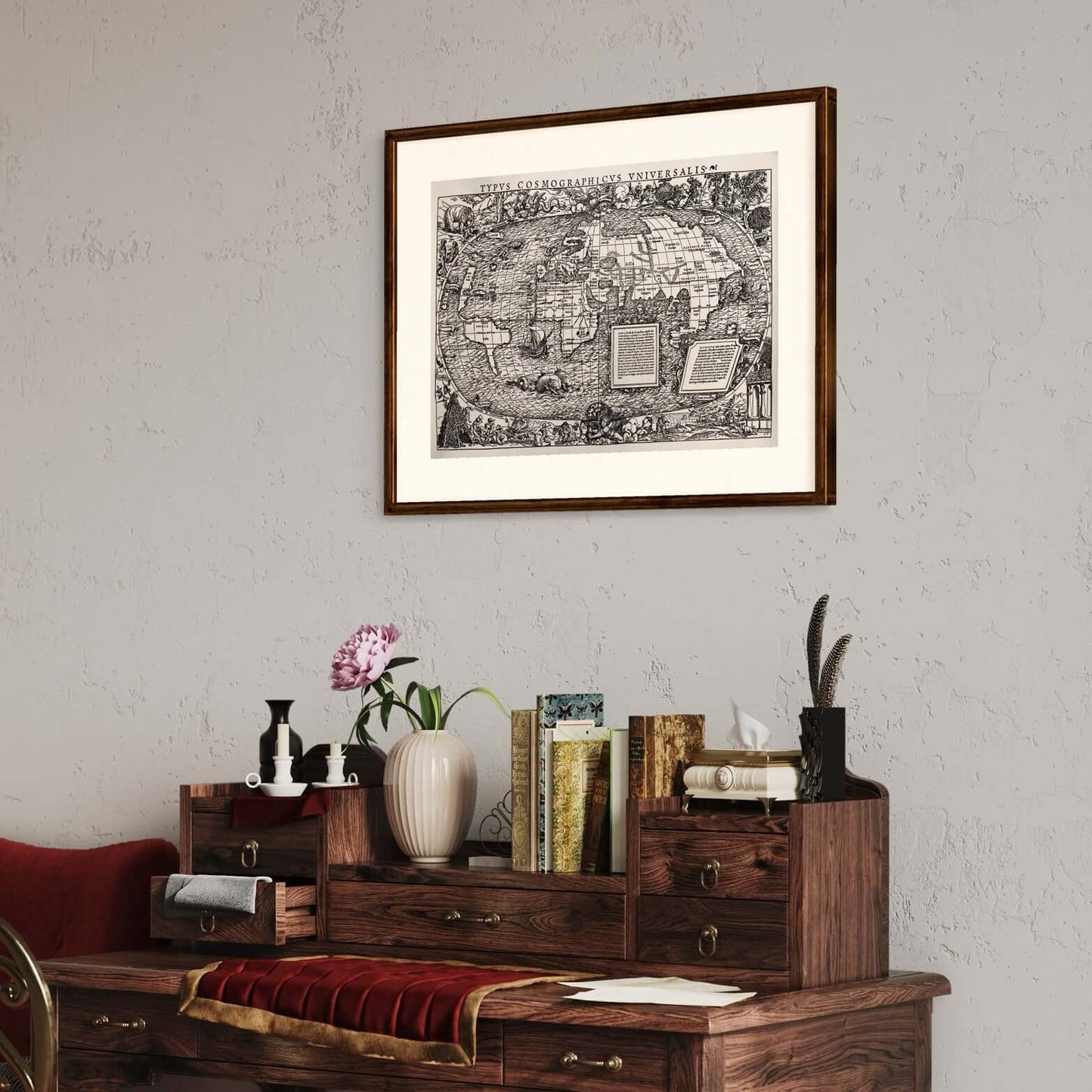
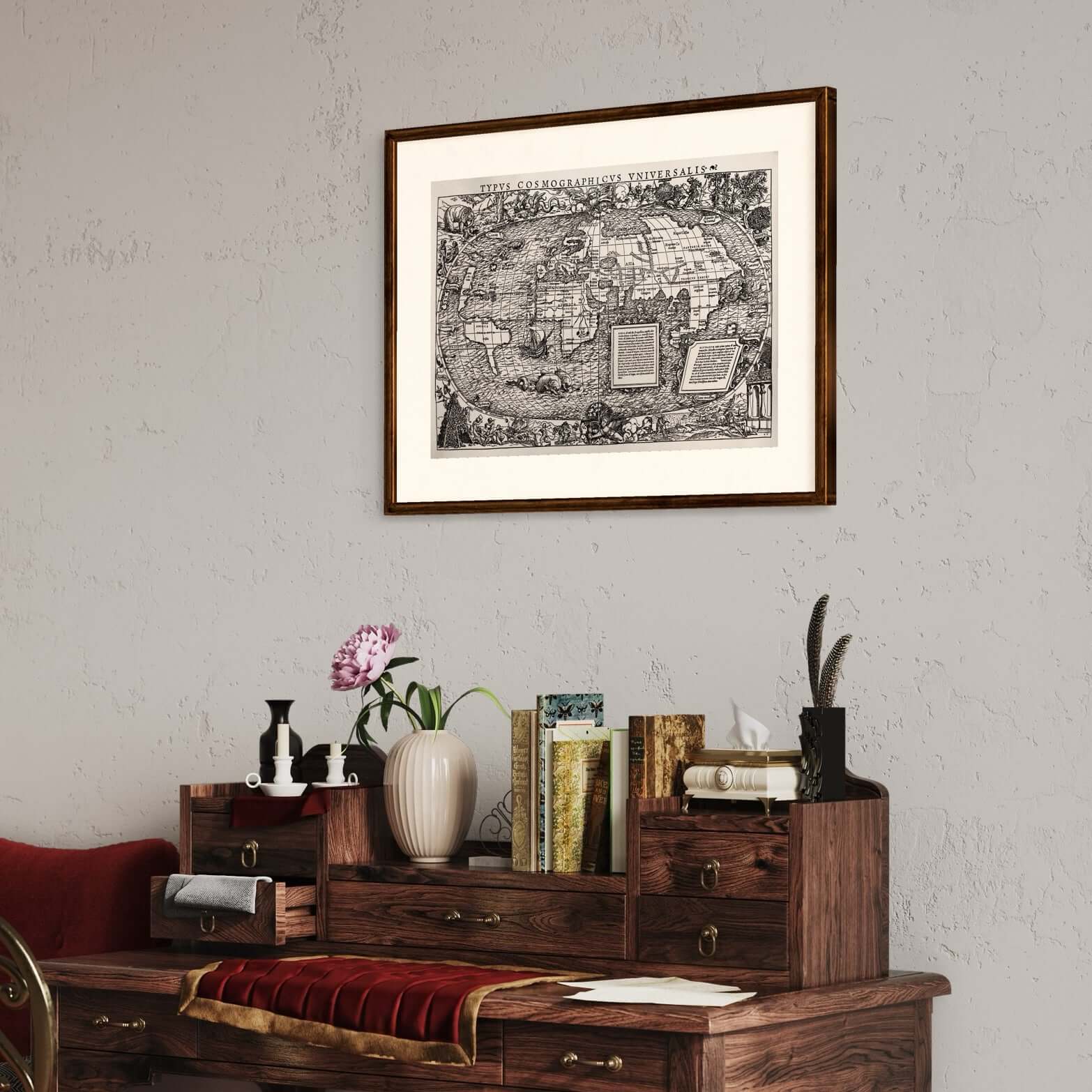
A black frame with gold details and exposed mounting is a fine option for displaying both the world map and the handmade Lessebo paper. Let the entire sheet, including any preserved deckle edge, be visible against a neutral background. Ask the framer to leave space from the glass and keep the map's decorations clear.
Product info
Product info
Paper size:620x500 mm
Print measurement: 580x395 mm
Type of paper: Handmade paper from Lessebo
Printing technique:Letterpress
Artist:Sebastian Muenster
The publishing year of the original:1531
The print year of the reproduction:1965